This article is a guide for customers on Hustly managed WordPress hosting plans, who are using our default setup. Users with WordPress setups similar to ours will find this guide useful as well.
Important DNS notice
Please note that updating your domain’s DNS and SSL settings will lead to your domain becoming unavailable temporarily.
If you are a Hustly customer and need assistance in making these changes, please create a support ticket to have your domains set up by us at no extra cost.
In order to configure your domain and install SSL certificates, you need to be logged into your hosting admin panel, ideally from a modern web browser on a desktop or laptop-sized device.
Before you start
Before you read this article, we assume that you have read and completed setting up the following:
You will need to add our nameservers to your domain name as “custom nameservers”.
Step 1: Changing your nameserver settings with your domain name registrar
Once you are logged in to your dashboard in the Hustly website management app, you can access both the IP address for your hosting server and your nameservers.
Upon logging in, scroll down to the IP & NAMESERVERS section to find your hosting server’s IP and nameserver. Please note that if you have multiple domain names or websites, each domain will have its own IP & nameserver settings.
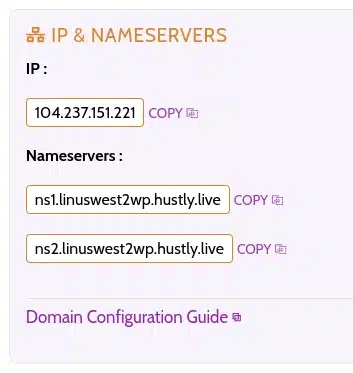
As you will notice in the image above, your custom nameservers will be of the format:
ns1.<your server name>
ns2.<your server name>
With most domain name registrars, you will need to login to your domain registrar’s account.
To use your Hustly server as your primary DNS, you will need to add your Hustly nameservers as your domain’s Nameserver to your domain registrar account.
A detailed guide with specific tutorials and screenshots for popular domain name registrars such as GoDaddy and Namecheap is published here by Plesk.
Step 2: Fine-tune your DNS settings
Find and click on the “Hosting & DNS” tab inside your hosting admin panel if you need to configure additional DNS settings for emails, SMTP, subdomains and more.

Step 3: Issue new SSL certificates for the new Domain
Find and navigate to the SSL/TLS certificate option for your domain on your hosting admin panel.
Click on “Reissue Certificates”.

Select the certificate you want, and complete the steps. Please note that you will need to scroll to the bottom and choose “Let’s Encrypt” for the Free option. The other SSL vendors will prompt you to pay for the certificate.
Your domain should now be configured
We hope you found this guide useful. If you have any questions, comments or feedback, please feel free to share your thoughts in the comments section below.